
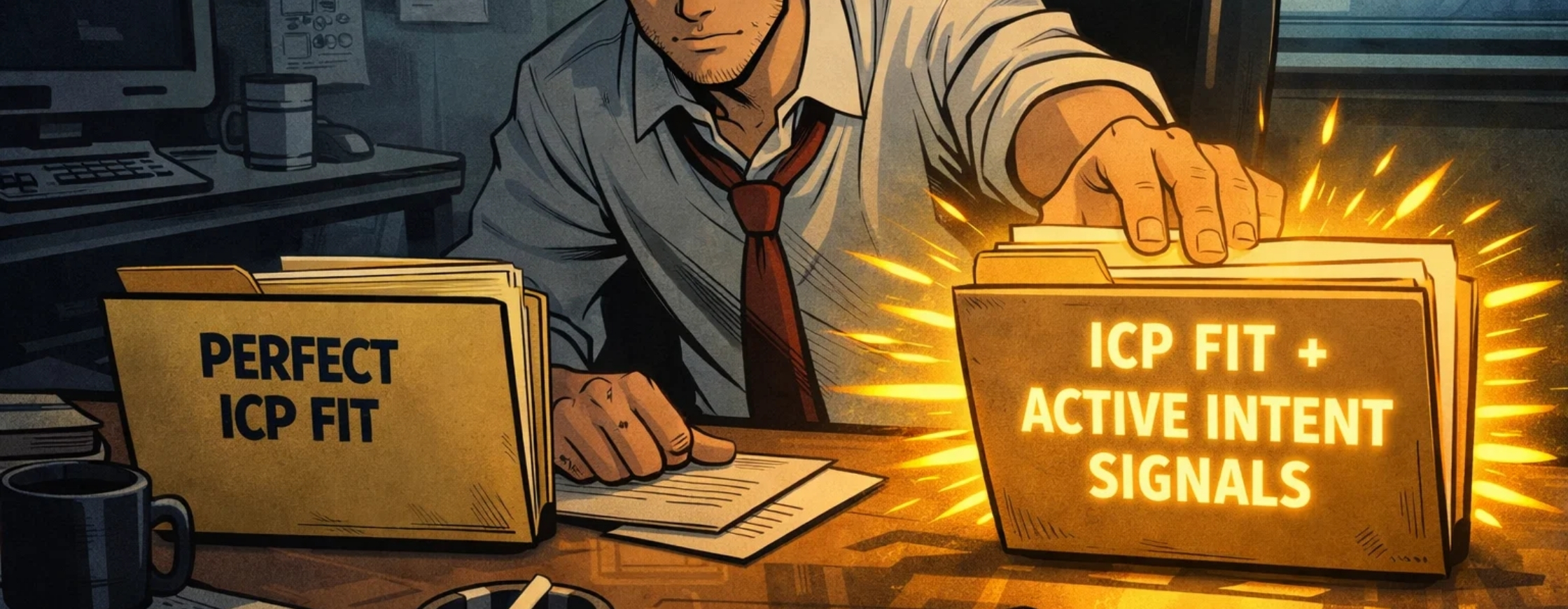

“High intent” is heard a lot in B2B sales, but it's not always defined with a ton of rigor. Too often, intent is reduced to a narrow set of actions or filters, and those lightweight signals get treated as decisive. That doesn’t mean intent data isn’t valuable. It means it’s frequently oversimplified. True buying intent shows up when large volumes of buyer behavior are analyzed together, across time, topics, and channels, and then anchored to a clear definition of who a team actually wants to sell to.
In practice, many teams label a lead as high intent after a pricing page visit, a content download, or a click on a follow-up email. Those actions might matter, but on their own, they don’t tell you much. Buyers click around for plenty of reasons that have nothing to do with an active purchasing decision: curiosity, competitive research, internal requests, or early-stage learning. Activity without context is cheap, and treating it as intent inflates pipeline without improving outcomes.
If you want pipeline that actually closes, intent has to be understood differently. Real opportunities tend to emerge at the intersection of sustained intent patterns, observed across many buyer signals, and deep ICP alignment. One without the other creates noise.
Why single intent signals don’t hold up anymore
B2B buying has become more complex, not less. More stakeholders are involved, more research happens before sales ever enters the picture, and buying journeys stretch across weeks or months.
In that environment, any single action is inherently ambiguous. Forrester reports that 86 percent of B2B purchases stall at some point during the buying process, often because buyers struggle to align internally or feel uncertain about next steps. That alone should make teams skeptical of treating one interaction as proof of readiness.
A pricing page visit might indicate real evaluation, or it might reflect budget planning or competitive benchmarking. A content download could signal late-stage interest, or someone simply trying to understand the basics. Without broader context, these signals don’t reliably predict outcomes.
High intent rarely comes from one moment. It comes from patterns.
Intent shows up as patterns, not isolated events
When teams analyze intent across millions or billions of buyer signals, certain behaviors consistently correlate with real buying motion.
Buyers who are moving toward a decision don’t just take one action. Their behavior accelerates. It converges around a specific problem. It spans multiple channels. They move from high-level exploration into more tactical questions about implementation, timelines, and tradeoffs.
What matters is velocity and direction. Signals that cluster tightly in time and point toward the same outcome are far more predictive than isolated actions spread out over long periods.
This is why many modern revenue teams are moving away from binary “in-market” labels. Gartner has noted that high-performing organizations increasingly correlate multiple intent signals with firmographic and technographic data to determine which accounts are actually worth prioritizing. Single signals simply don’t predict revenue consistently enough anymore.
ICP fit is necessary, but it doesn’t create urgency
On the other side of the equation is ICP fit. You still need to know you’re talking to the right kinds of companies. Fit tells you whether an account could buy your product.
What fit doesn’t tell you is whether they’re trying to buy anything right now.
A company can look perfect on paper and still be months away from taking action. Chasing fit without intent leads to long nurture cycles, low response rates, and frustrated reps. Intent without fit creates a different problem: plenty of activity that never turns into real deals.
Wins happen when both are present at the same time.
Where pipeline actually tightens up
When strong intent patterns line up with deep ICP alignment, sales conversations change.
Outreach feels timely instead of interruptive. Reps aren’t guessing why they’re reaching out. The reason is obvious. Buyers are more receptive because the message matches what they’re already evaluating.
Research from SiriusDecisions has shown that teams combining intent behavior analysis with ICP-based qualification see higher opportunity conversion rates and shorter sales cycles than teams relying on intent signals alone. That tracks intuitively. You’re prioritizing probability instead of noise.
This is also where pipeline starts to feel honest. Fewer accounts receive attention, but the ones that do are far more likely to move forward.
Why intent-only approaches struggled for so long
For a long time, intent data was limited. Teams worked with clicks, visits, and downloads, so those signals were treated as decisive.
Buyers evolved faster than those models.
Today’s buyers self-educate quietly. They research across vendors before ever raising a hand. They disappear and reappear. One moment of interest doesn’t carry the same weight it once did.
That’s why pattern recognition matters now. Looking across large volumes of buyer behavior makes it possible to distinguish curiosity from commitment and early exploration from active evaluation.
Some teams are already using AI to surface these patterns automatically, instead of asking reps to interpret dozens of disconnected signals on their own. The goal isn’t more data. It’s clearer meaning.
What sales teams should take away
If pipeline quality is the goal, chasing every signal harder isn’t the answer. Being more selective is.
Instead of asking whether someone clicked, ask what their recent behavior says about timing. Instead of prioritizing every high-fit account, focus on the ones showing momentum right now.
When sustained intent patterns and deep ICP alignment come together, sales stops being reactive. It becomes precise.
That’s when pipeline starts to close.
If you want to see how teams are identifying these intersections in practice, and how large-scale intent patterns paired with deep ICP matching translate into sales-ready opportunities, you can explore how this approach is reshaping modern prospecting here 👉 https://get.bebop.ai
.png)
.png)
.png)
